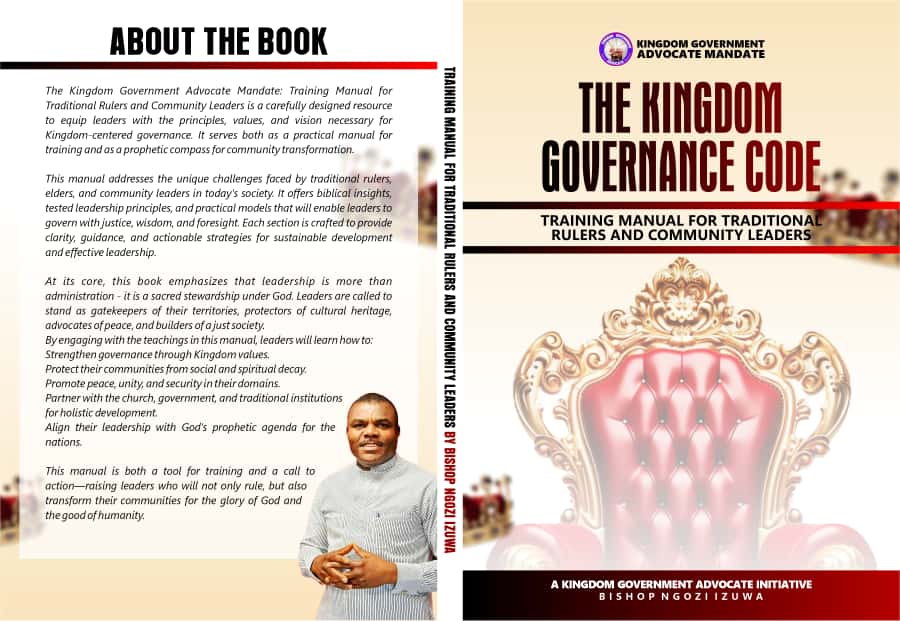
“CODES OF THE KINGDOM: Kingdom Governance Principles for Chiefs, Elders, and Community Leaders” is a leadership blueprint designed to restore, strengthen, and guide moral, cultural, and governmental authority within communities through the lens of “kingdom” wisdom. It addresses the unique responsibilities of chiefs, elders, traditional rulers, and organizational leaders who serve as custodians of societal order, cultural identity, and generational legacy.
The book argues that leadership is not merely an administrative role, but a sacred trust — a guardian assignment rooted in moral codes, divine principles, and community-centered stewardship. Drawing from ancient kingdom models, timeless moral laws, and practical governance strategies, it provides leaders with a framework for ruling with justice, wisdom, and long-term vision.
Core Themes
1. The Nature of Kingdom Governance
The book opens by reframing leadership as a covenant, not a career. True kingdom leadership flows from:
- Purpose-driven authority
- Accountability to a higher moral law
- Service to the people as bearers of divine image
Leaders are presented as stewards of order, entrusted to maintain peace, justice, and cultural continuity.
2. The Leader’s Identity and Moral Code
Central to the book is the idea that governance collapses when leaders lose personal integrity. It sets forth foundational “codes”—ethical principles every chief, elder, or community leader must embody:
- Righteousness and fairness
- Honor and humility
- Truthfulness and consistency
- Self-discipline and emotional maturity
- A lifestyle that reinforces respect and trust
The character of the leader is described as the first form of law a community experiences.
3. Wisdom as the Currency of Leadership
The book teaches that wisdom, not power, sustains nations. Leaders are encouraged to:
- Seek counsel
- Govern with long-term vision
- Understand community psychology
- Recognize consequences before making decisions
Elders are portrayed as wisdom-bearers whose insight shapes the destiny of communities.
4. Justice and Conflict Resolution
The text presents justice as the backbone of kingdom governance. It outlines:
- Fair dispute resolution systems
- Restorative justice principles
- Handling inter-family and inter-clan conflicts
- Balancing compassion with law
- Addressing corruption and mismanagement
A leader’s authority is tied directly to their ability to uphold impartial judgment.
5. Cultural Preservation and Identity Formation
The book emphasizes that chiefs and elders are gatekeepers of:
- Traditions
- Community history
- Values and collective memory
- Rituals, symbols, and customs
Governance includes the responsibility of protecting cultural wealth from erosion and guiding communities through modernization without losing identity.
6. Community Building and Social Structures
The author outlines how leaders create environments where people flourish.
Principles include:
- Encouraging unity and social cohesion
- Supporting families and youth development
- Promoting education and economic empowerment
- Facilitating collaboration across clans or sectors
- Modeling servant leadership
Leadership is presented as the art of shaping a healthy community ecosystem.
7. Visionary Leadership and Future Stewardship
The final sections focus on longevity and legacy. Leaders are urged to:
- Think generationally
- Raise successors
- Plan developmental strategies
- Instill values that outlive them
- Avoid reactive governance and govern with purpose
The book concludes that the kingdom thrives when leaders build structures and cultures that remain strong long after their tenure.
Overall Message
“Codes of the Kingdom” is ultimately a call for leaders to rise into noble, principled, and transformative governance. It combines ethical formation, spiritual understanding, cultural guardianship, and practical leadership strategy into a unified framework.
It is both a manual for emerging leaders and a mirror for experienced ones, urging them to embody integrity, wisdom, justice, and vision as they guide their communities toward peace, prosperity, and moral strength.
Author: Bishop Ngozi Izuwa
Available on: Amazon Books (https://www.amazon.com/-/e/B0G2GM583X)
No responses yet